
Aion

Today’s artifact is a beautiful gold Roman coin depicting the god Aion. This little thing is packed with profound meaning. There is a high-resolution image on The British Museum’s website.
The frontof the coin contains a bust of Hadrian. The back of the coin is described thusly: “Aion, standing right, holding phoenix on globe, he is emerging from the Zodiac in the form of an oval frame.”
We know Hadrian lived from 117AD to 138AD, which of course puts him contemporary to early Christianity. Aion, on the other hand, is a god that encoded some very specific and profound truths about the world.
The Greco-Roman world had different gods who represented different aspects of time. On the one hand, there was Kronos/Saturn, who represented linear time. Time as what we think of as time. You can think of this as mortality, the fallen world, etc. One website notes that Kronus’ relation to time was “in particular time when viewed as a destructive, all-devouring force.”
Aion was a different kind of time. “Unbounded” is a word that frequently describes the kind of time that Aion represents. Aion was a very popular deity in the Greco-Roman world, as evidenced by his appearance on a coin opposite Hadrian. The Romans also had a goddess of eternal time, Aeternitas. I have seen some sources call Aeternitas Aion’s consort, but I am not certain that was a widespread belief in antiquity. Aeternitas was connected to the belief in the eternal right of Roman rule. Aion was more associated with mystery schools and ideas of cyclical time. In some way, as we will see, Aion would predict the time when Roman rule would inevitably collapse.
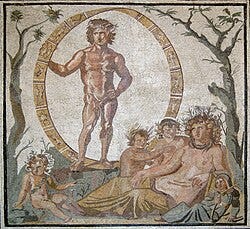
The above mosaic depicts Aion standing on the zodiac. The zodiac forms a loop, just like it does in the sky. From Wikipedia: “The imagery of the twining serpent is connected to the hoop or wheel through the ouroboros, a ring formed by a snake holding the tip of its tail in its mouth. The 4th century CE Latin commentator Servius notes that the image of a snake biting its tail represents the cyclical nature of the year.” For more information on the zodiac, see my old post.
The zodiac represents not only annual time, but also longer periods of time, frequently called the Platonic year, or the great year. This is a cycle of roughly 26,000 years, containing four season, of which the solar year is a fractal part (just like the day is a fractal part of the year, and the year is a fractal part of the saeculum). The zodiac runs in an eternal loop, year after year, great year after great year. Thus, eternal time is understood, not as something disappearing into an unknowable horizon, but something forever looping back around on itself.
Aion is also holding a phoenix. The mythological phoenix goes back at least to ancient Egypt. Britannica notes that it is associated with worship of the sun. The phoenix lived, grew old, and then combusted. From its ashes a new phoenix emerged, which then repeated the cycle. Britannica also notes that “the Egyptians associated the phoenix with immortality, and that symbolism had a widespread appeal in late antiquity.” You can see how this fits neatly into the eternal nature of Aion’s kind of time. However, also encoded in that myth is the idea that things must die and be reborn as part of the cycle of eternal time. In the physical realm, this probably related to the earth’s disaster cycle, the concept that the earth is periodically destroyed and repopulated, again and again. The fact that the phoenix is atop the globe with Aion on the gold coin above supports the claim that the earth runs on a disaster cycle. From the perspective of the soul, this relates to the concept of reincarnation, continual death and rebirth until the soul ascends beyond it, something in every Indo-European tradition of which I am aware.
Knowing the context of this widespread concept in the Greco-Roman world of the early Christian church, I find it peculiar that this word was so badly mistranslated into English at times in our Bibles. The Greek “aion,” not as a proper noun, appears 102 times in the New Testament (Strong’s entry 165). Outside of the Bible, this word is frequently translated as “age,” sometimes associated with the various, roughly 2,000 year, periods of the zodiac. This makes sense, given the association with the deity. The Oxford Classical Dictionary also relates this word to concepts of “life/vital force,” “whole lifetime,” and “generation.” Generation and lifetime bring us close to the concept of the saeculum, which also makes sense, as this is something of a mini great year, very much a period of cyclical time from the human perspective.
What this word is not, is the “world,” as in the Earth, the land, or the globe. Aion is at times translated into “this world” in English translations of the Bible. “it shall not be forgiven him, neither in this aion, neither in the one to come.” Matthew 12:32. “The enemy that sowed them is the devil; the harvest is the end of the aion . . . So shall it be at the end of the aion.” Matthew 13:39, 49. “Known unto God are all his works from the beginning of the aion.” Acts 15:18. But we speak the wisdom of God in a mystery, even the hidden wisdom, which God ordained before the aion unto our glory.” 1 Corinthians 2:7. Some usages definitely seem to be pointed to the idea of eternity, such as Matthew 6:13: “for thine is the kingdom, and the power, and the glory, for ever.” “Forever,” is aion. As you can see, translating “aion” into “world” is highly tendentious and relying on that English word brings a lot of baggage that may not be consistent with the author’s intent. At a minimum, this should be debated.
Other concepts of time appear in the New Testament. Strong’s 5550 is the entry for “chronos.” Here we see time as something occurring once, as in “the time that thing happened,” or time in the mortal sense. For example, “Then Herod, when he had privily called the wise men, enquired of them diligently what time (chronon) the star appeared.” Matthew 2:7. “After a long time (chronon) the lord of those servants cometh, and reckoneth with them.” Matthew 25:19. “And though he would not for a while (chronon): but afterward he said within himself, Though I fear not God, nor regard man . . .” Luke 18:4. Perhaps most curiously: “And the angel which I saw stand upon the sea and upon the earth lifted up his hand to heaven, and sware by him that liveth for ever and ever, who created heaven, and the things that therein are, and the earth, and the things that therein are, and the sea, and the things which are therein, that there should be time (chronos) no longer.” Revelation 10:5-6. Incidentally, “earth” in this passage is the word “gen,” Strong’s 1093, usually appearing as “land” or “earth” in English, such as “Nor by the earth, for it is his footstool,” Matthew 5:35, or “Till heaven and earth pass, one jot or one tittle shall in no wise pass from the law,” Matthew 5:18, or “thy will be done on earth as it is in heaven,” Matthew 6:10.
The word “kairos” also appears in the New Testament. One post puts it this way: “Chronos is about sequential time as we often think of it—clocks, calendars, and weekend plans. It’s where we get words like chronological. Kairos is about the right season or occasion. Some Greek dictionaries define it as ‘appointed’ time. Jesus came into the world on kairos time—precisely the right time.” Incidentally, in his post on “The 2 Concepts of Time in the Bible,” the author misses that aion is present as yet another kind of time in the Bible.
As such, “the end of the world” seems to be a particularly bad translation, which has led to a lot of poor understanding of things. It is not “the world” or “the earth” that passes, but it is a cycle that passes, an age that comes and goes. More and more, I agree with the minority of early christians that argued that Revelation should not have been canonized. Canonizing that book was like giving a line of quality cocaine to a ten year old. In modern times, it’s a lot like the mule with a spinning wheel, or the town with money, “no one knows how he got it, and danged if he knows how to use it.”
As I’ve shown in a couple entries, and will continue to show in future posts, Revelation is a mash of ancient Indo-European imagery and myth with the very correct, even prophetic, message of “that stuff that happened last time, it’s going to happen again.” But that prophecy was not unique to Christendom. The Indo Europeans already understood that very well. They condensed the message of Revelation onto the back of a gold coin.